1. Start with what llm-d is not
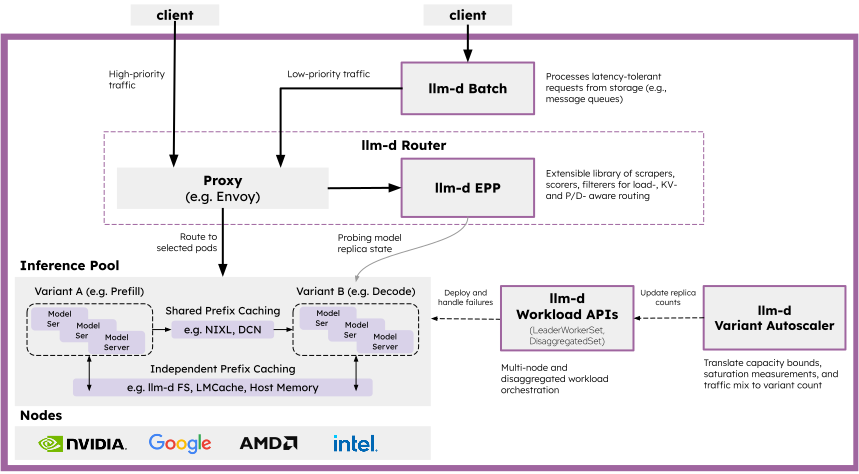
llm-d is not a language model, a complete replacement for engines such as vLLM or SGLang, or a consumer API. It is an open orchestration layer above model servers and Kubernetes: it receives requests, selects endpoints, tracks KV-cache state and coordinates serving groups and scaling.
Do not compare it with a closed model on answer quality. Compare an existing serving design—perhaps generic load balancing and a fixed GPU pool—with an inference-aware control plane that can use workload, context and priority signals.
2. What 1.0 adds for Day 2 operations
The project frames 1.0 as a move from performance proofs to persistent operations. It introduces a stable v1 configuration API, priority- and fairness-aware flow control, coordinated rollouts for prefill/decode groups, and session-aware routing that attempts to return a conversation to a replica holding its context.
These are capabilities, not automatic guarantees. Zero-downtime upgrades still require correct high availability, failure tests, version compatibility and observability. “Agent-aware” means better handling of sessions and turns; it does not build the agent or validate its decisions.
3. Why split prefill from decode?
Reading a long prompt and building its initial state is compute-heavy. Producing later tokens is more constrained by memory and bandwidth. Disaggregation lets operators size different pools for each phase and transfer KV state over a fast network instead of forcing every replica to handle both in the same ratio.
The gain has a cost: new data movement, dependence on RDMA or transfer connectors, and a need to coordinate both sides. For a small or short-context workload, a simpler deployment may win. Version 1.0 makes disaggregation more operable; it does not make it universally correct.
4. Treat the performance numbers as test cases, not purchase promises
The project reports examples including three times higher output throughput for cache-aware routing against round robin, plus other gains from disaggregation and KV movement. Each result is tied to a model, accelerator, concurrency level, context shape and baseline. AI World Signal did not reproduce those benchmarks, so we attribute them to the project and its partners.
A procurement test should replay real prompt and output lengths, prefix reuse, concurrency, priority bands and time-to-first-token targets. Measure failure and upgrade behaviour as well as averages. The operational objective is a service that remains predictable under pressure.
5. Worked decision: when is an llm-d pilot justified?
Imagine one internal model on four GPUs with stable traffic, no service tiers and short sessions. llm-d may add complexity before value. If the platform serves several tenants, sees bursty long-context agents, needs interruption-free upgrades or spans heterogeneous hardware, a controlled pilot becomes reasonable.
Capture one week of baseline data, then run a bounded trial with representative traffic. Success is not a Helm chart that deployed. It is a latency-and-cost target met alongside controlled failure and a documented rollback. Keep the comparison: version 1.0 is a stable foundation, not the project's finish line.