1. Two systems, not one headline
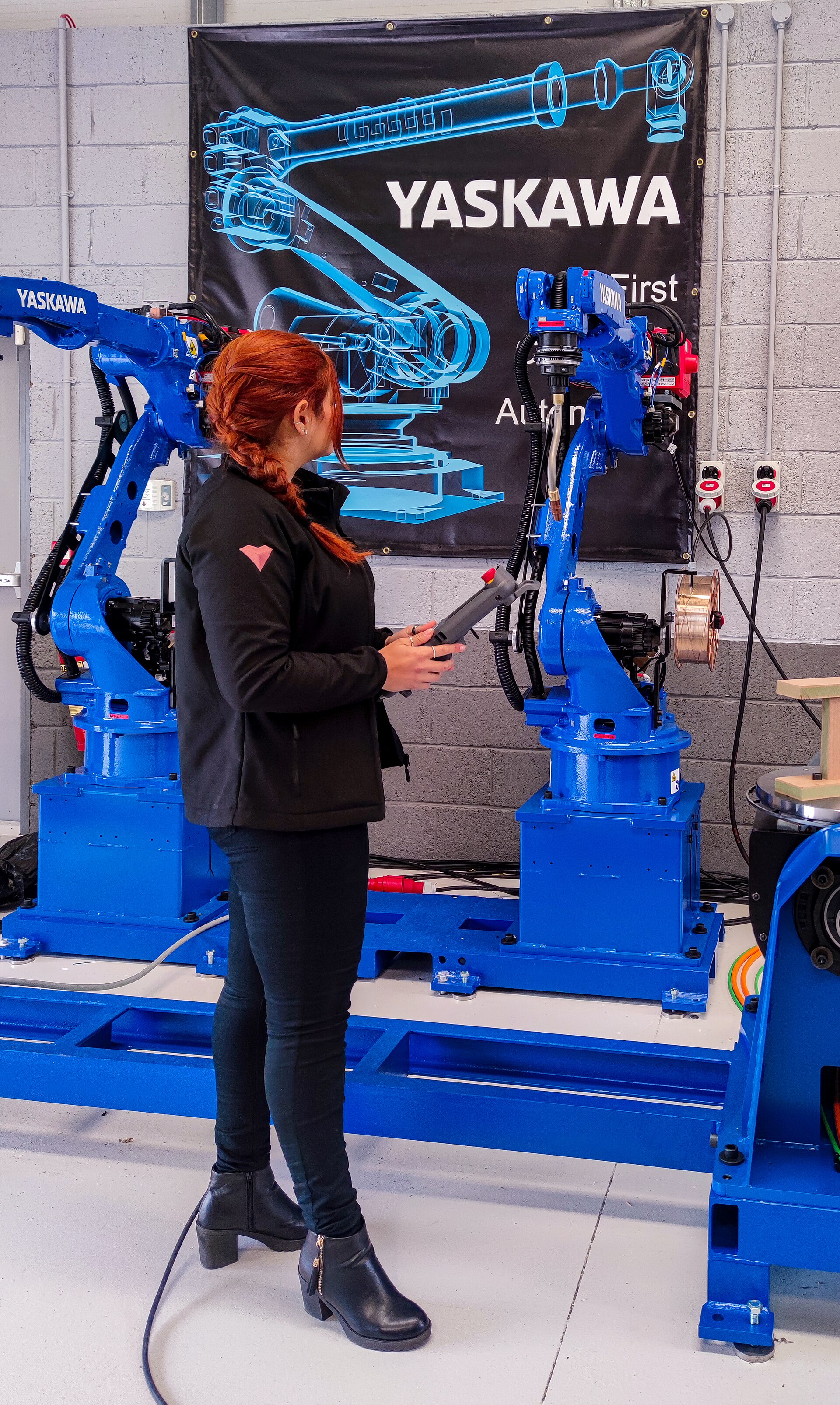
On July 15, Yaskawa announced development of an agentic system connecting MOTOMAN NEXT to Google DeepMind’s Gemini Robotics-ER 1.6. Yaskawa says a broad instruction such as “sort these parts” can prompt the system to inspect the scene, construct a procedure and execute it without a human writing every motion. It also describes recovery after a dropped object and links to production-management systems.
Two days earlier, SoftBank and Yaskawa reported a separate wire-harness demonstration. A vision-language-action system recognized the changing object, while a GPU-cloud workflow supported motion-data collection, synthetic augmentation, training, simulation evaluation and deployment to the physical robot. The first emphasizes agentic planning; the second tackles learned control of deformable objects.
2. Why a cable is harder than a rigid box
Traditional automation works well when position, geometry and trajectory are known. A wire, cloth or bag can sag, bend, tangle and move its grasp point after every action. Stored coordinates are insufficient: the system has to observe the current state, select a new action and verify the result.
The companies say the demonstration confirmed stable wire-harness handling. That is a bounded validation, not a published success rate across thousands of parts or an independent comparison. The releases do not provide trial count, cycle time, failure rate or human-intervention frequency. The demonstrated development loop is significant; a general solution to deformable manipulation is not established.
3. The agentic-robot stack
Gemini Robotics-ER 1.6 acts as a high-level reasoner: it interprets the scene, decomposes the goal, estimates progress and decides when to retry. It does not replace motion control, torque sensing or safe speed limits. Yaskawa’s control engineering turns a semantic plan into executable, bounded movement.
In SoftBank’s loop, robot and sensor data are collected, augmented with synthetic data using NVIDIA Cosmos, used for GPU training, tested in simulation built with Omniverse libraries, and then deployed. Simulation reduces the need to run every experiment on hardware, but it does not eliminate the sim-to-real gap or site testing.
- Goal: a broad human command or production-system task.
- Perception: cameras and sensors establish current state.
- Planning: an embodied model decomposes work and detects success.
- Execution: the robot controller bounds paths, forces and speed.
- Learning: real, synthetic and simulated data improve the model.
4. What is completed—and what remains announced
Yaskawa completed a development announcement and demonstrated planning and recovery features; SoftBank and Yaskawa completed the wire-harness demonstration. Yaskawa explicitly said application areas and availability would be announced when preparations are complete. The July 15 release therefore provides no sale date, price or commercial support specification.
SoftBank’s GPU cloud was also not a fully launched commercial service at verification. Beta use began May 25, while October 2026 was the announced launch target. Claims of faster development and easier deployment come from project participants without an independent cost study. Development, validation, beta, planned launch and proven commercial operation should remain separate labels.
5. Autonomy does not replace machine safety
A system that can re-plan expands the set of possible motions, increasing the need to separate task intelligence from safety functions. ISO 10218-1:2025 addresses the robot’s inherent safety and risk reduction; Part 2 covers application and cell integration. Model-level safety does not replace guarding, safe stop, force and speed limits, lockout or application risk assessment.
OSHA notes that many robot accidents occur during non-routine programming, maintenance, testing, setup or adjustment, when a worker may enter the operating envelope. Recovery therefore needs its own rules: when may the robot retry, when must it stop, who approves a new plan, and what happens when a camera, network or model becomes unreliable? A production robot must fail within known boundaries.
6. A practical deployment test
Factories should start with one variable, costly or hazardous task—not a general “smart robot” purchase. Establish baseline cycle time, defects, interventions and safety exposure, then run a bounded cell with auditable stops. Ask for success and failure distributions, not a highlight video.
Measure cost per successful task, human interventions, recovery time and production loss during downtime. Test low connectivity, sensor loss and novel objects. Confirm who owns video and motion data and whether models and logs are portable. If simpler automation or better mechanical design wins on outcome and reliability, extra intelligence is complexity rather than return.
- Start with one variable, high-value task.
- Require detailed success and failure data.
- Keep safety controls independent from generative models and cloud.
- Test degraded operation and human takeover.
- Contract for data ownership, audit logs and portability.